Phylogenetics in the microbiome with SuchLinkedTrees
Article available as a Jupyter Notebook: SuchTree_2.ipynb
In the last article, we saw how to use SuchTree to probe the topology of
very large trees. In this article, we're going to look at the other component
of the package, SuchLinkedTrees.
If you are interested in studying how two groups of organisms interact (or, rather, have interacted over evolutionary time), you will find yourself with two trees of distinct groups of taxa that are linked by a matrix of interaction observations. This is sometimes called a 'dueling trees' problem.
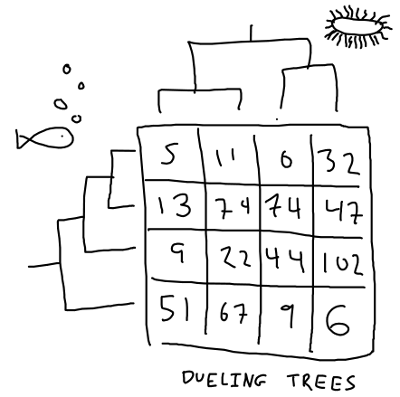
If the trees happen to have the same number of taxa, and the interaction matrix happens to be a unit matrix, then you can compute the distance matrix for each of your trees and use the Mantel test to compare them. However, this is a pretty special case. Hommola et al. describe a method extends the Mantel test in this paper here :
- A Permutation Test of Host–Parasite Cospeciation. Molecular Biology and Evolution, Vol. 26, No. 7. (01 July 2009), pp. 1457-1468, by Kerstin Hommola, Judith E. Smith, Yang Qiu, Walter R. Gilks
This is implemented in scikit-bio as hommola_cospeciation.
Unfortunately, the version in scikit-bio does not scale to very large trees,
and does not expose the computed distances for analysis. This is where
SuchLinkedTrees can help.